Thad summons the sparrows
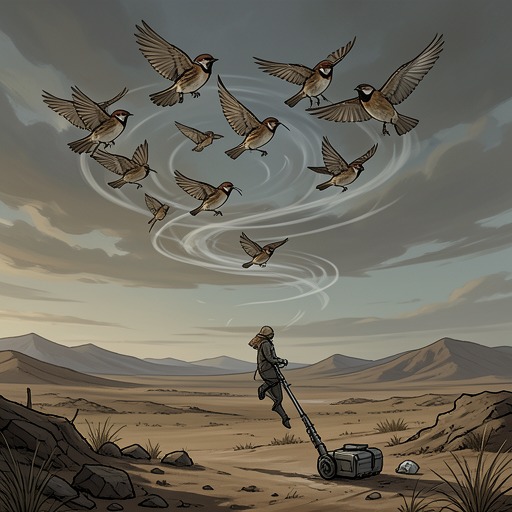
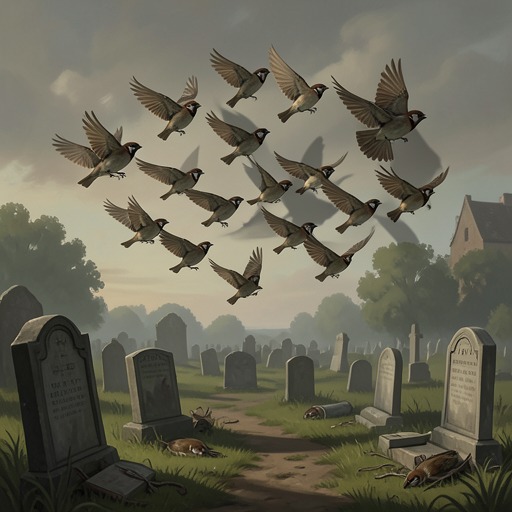
The Dark HalfThad summons the sparrows as psychopomps: first at Gold’s Junkyard and Auto Supply, where he asks the birds to find George Stark and watches them depart west, and later, in the decisive confrontation at the lake house, when he uses a bird-call and written words to set their flight in motion again. The event links Thad’s investigation of a childhood mystery to the supernatural force that ultimately carries Stark away.
Folklore and the First Encounter
Thad’s attempt to understand the birds begins with a question about Rawlie DeLesseps’s Folk Myth seminar. When Rawlie tells him that he may have found what Thad was looking for, he turns to Barringer’s Folklore of America and explains that sparrows, loons, and whippoorwills are regarded as psychopomps—conductors between the living and the dead. Loons and whippoorwills are said to gather near an impending death and guide the newly dead onward. Sparrows have a more unsettling role: in Barringer’s account, they are outriders of the deceased, guiding lost souls back into the land of the living. Rawlie calls them harbingers of the living dead.
That account gives Thad a framework for the birds, but it does not explain his own connection to them. At Gold’s Junkyard and Auto Supply, he drives among wrecked cars and begins seeing sparrows on roofs, trunks, engines, and a windshield. They remain in place as he passes. When he notices dried blood inside a damaged Datsun and finds more birds gathered nearby, the folklore stops being an abstract possibility and becomes an immediate question: what do the sparrows want with him?
Thad asks the birds what they want. In response, he seems to hear a single collective voice in his mind, telling him that the question is reversed: he is the owner, the bringer, and the knower. Thad does not understand the answer, but its repeated titles establish an unusual relation between him and the flock. The birds do not merely appear around him; they identify him as someone with a part to play in their movement.
The Summons at the Junkyard
The gathering grows until the wrecked vehicles on the junkyard’s back ten acres are carpeted with sparrows. The flock has arrived without Thad hearing it come, and it remains completely still. Rawlie recognizes the birds as the psychopomps and asks what their presence means. Thad replies that he is only beginning to understand.
The birds’ attention is selective. Rawlie claps his hands, but the flock does not stir; it is Thad, rather than Rawlie, whom the sparrows watch. Thad then gives a quiet command: find George Stark and fly. The birds rise together into a dark cloud, turn in the sky, and head west. Their departure is a concrete response to Thad’s request, not merely a sign that he has recognized them. The summons makes the flock an active participant in the search for Stark.
The flight briefly merges with the onset of Thad’s earlier trances: for him, past and present seem to entwine as the birds vanish. The scene thus connects his present command to the recurring visions that have accompanied his experiences of the sparrows. It also turns Rawlie’s folklore into practical knowledge: the birds have gathered around Thad, answered him in some fashion, and gone where he directed them.
The Flock Returns
The sparrows appear again as Alan Pangborn approaches the Beaumont lake house. They occupy the roof and surrounding trees of the Williams family’s cottage, as well as the rocks and dock by the shore; there are hundreds. They remain silent and watch Alan. When he moves, more birds arrive and settle in the trees, surrounding him while leaving the woods beside Lake Lane clear. A sparrow lands on his shoulder and then his hand before returning to the driveway. The birds’ measured proximity gives the flock a presence independent of the people trying to interpret it: they approach, watch, and hold their ground without responding like ordinary startled birds.
Thad encounters the gathering on the road as he drives toward the house. A sparrow settles on the hood of his Volkswagen and peers through the window. He understands that reaching the house means driving over the birds covering the road. The flock has become not only an omen or a means of tracking Stark but a physical barrier between Thad and his destination.
The Final Call and Its Consequence
At the lake house, Thad prepares for another summons while George Stark is absorbed in writing. Thad takes the bird-call Rawlie gave him and keeps it cupped in his hand. He writes three declarations in his notebook: he is the bringer, the knower, and the owner. As he writes, the birds’ movement overhead stops, and the room seems to listen. The repeated words recall the collective message Thad heard at the junkyard, but now he writes them deliberately, making his role part of the confrontation with Stark.
Thad then writes PSYCHOPOMPS, circles it, and adds THE SPARROWS ARE FLYING. He blows the bird-call, whose note is followed by the sound of the flock rising outside. Stark stops writing and recognizes the danger too late. The summoned birds are not simply tracking him now: they have come as his escort back to Endsville, the land of the dead. Their arrival reverses the direction established at the junkyard. There, Thad sent them west to find Stark; here, they reach Stark and carry out the passage associated with their folkloric role.
The event’s significance lies in the change from interpretation to agency. Rawlie’s account names the sparrows’ traditional function, the junkyard scene establishes their selective attention to Thad, and the later summons brings that function to bear on Stark. Thad can call the psychopomps and direct them, but their power is not reduced to a human instrument: the flock’s gathering, silence, and final return give the birds an independent force in the story’s resolution.